Positive Definite Matrices
Properties
Section titled “Properties”A symmetric matrix is positive definite (PD), if it has the following equivalent properties. Positive definiteness is a notion of thinking about symmetric matrices as positive or negative in the same sense as one would think about a real number.
- All eigenvalues of are positive, i.e., .
- For any vector , the energy contained in for is positive, i.e.,
- All leading determinants of are . Leading determinants are determinants of all square sub-matrices of with the top-left corner fixed.
- All pivots in the Gaussian elimination are .
- can be factored as , where has independent columns.
Energy in a vector
Section titled “Energy in a vector x\xvx”For a matrix , the energy in a vector is defined to be . For example, consider
The corresponding energy is . Below is the plot for showing that energy for all and . Thus, the matrix in this example is positive definite.
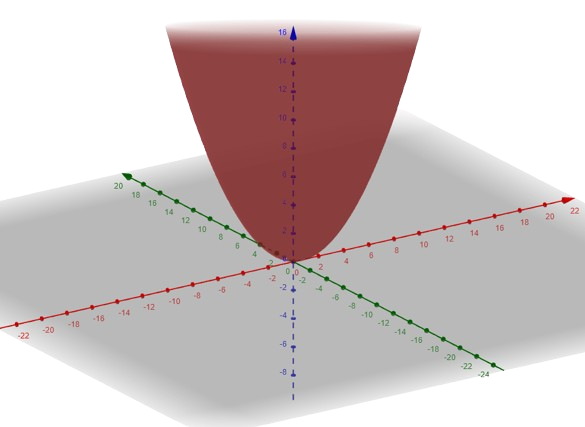
On a side note, this can be seen like a loss function that one may try to minimize using something simple like gradient descent.
If two matrices and are PD, then so are the matrices and . This can be easily seen by the positive energy property and the fact that if is an eigenvalue of then is an eigenvalue of .
Positive semi-definite matrices
Section titled “Positive semi-definite matrices”Positive semi-definiteness (PSD) is analogous to being non-negative. A matrix is PSD if it satisfies the above properties with a minor change: replace with in the first four properties, and in the last property, we may have dependent columns in the factor .