Skip to content

Portmanteau Theorem

First, we need a definition.

The Portmanteau Theorem provides several equivalent definitions of weak convergence. It connects the convergence of distribution functions to the convergence of expectations of bounded continuous functions and probabilities of μ\mu-continuity sets.

Given Xn→dXX_n \xrightarrow{d} X, by Skorohod’s Representation Theorem, there exist random variables YnY_n and YY on a common probability space such that:

Yn=dXn,Y=dX,andYn→a.s.YY_n \stackrel{d}{=} X_n, \quad Y \stackrel{d}{=} X, \quad \text{and} \quad Y_n \xrightarrow{a.s.} Y
  1. Since Yn=dXnY_n \stackrel{d}{=} X_n and Y=dXY \stackrel{d}{=} X, we have: E[f(Xn)]=E[f(Yn)]andE[f(X)]=E[f(Y)]\mathbb{E}[f(X_n)] = \mathbb{E}[f(Y_n)] \quad \text{and} \quad \mathbb{E}[f(X)] = \mathbb{E}[f(Y)]
  2. Since ff is continuous and Yn→a.s.YY_n \xrightarrow{a.s.} Y, we have: f(Yn)→a.s.f(Y)f(Y_n) \xrightarrow{a.s.} f(Y)
  3. Moreover, since ff is bounded, by the DCT: E[f(Yn)]→E[f(Y)]\mathbb{E}[f(Y_n)] \to \mathbb{E}[f(Y)]

Combining everything, we obtain E[f(Xn)]→E[f(X)]\mathbb{E}[f(X_n)] \to \mathbb{E}[f(X)].

Assume condition 2 holds: E[f(Xn)]→E[f(X)]\mathbb{E}[f(X_n)] \to \mathbb{E}[f(X)] for all bounded continuous ff. We want to show Fn(x)→F(x)F_n(x) \to F(x) for any point xx where FF is continuous.

Note that Fn(x)=E[1(−∞,x](Xn)]F_n(x) = \mathbb{E}[\mathbb{1}_{(-\infty, x]}(X_n)]. The indicator 1(−∞,x]\mathbb{1}_{(-\infty, x]} is not continuous (jump at xx), so we cannot apply condition 2 directly. Instead, we approximate the indicator function with continuous functions.

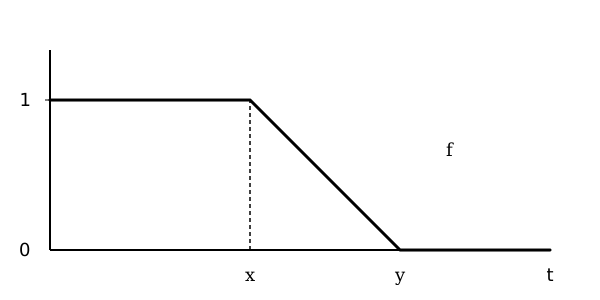
For any xx and any y>xy > x, define a continuous function fx,y(t)f_{x,y}(t):

f(t)={1t≤xy−ty−xx<t<y0t≥yf(t) = \begin{cases} 1 & t \le x \\ \frac{y-t}{y-x} & x < t < y \\ 0 & t \ge y \end{cases}

Approximation Function

Observe that 1(−∞,x]≤f≤1(−∞,y]\mathbb{1}_{(-\infty, x]} \le f \le \mathbb{1}_{(-\infty, y]}.

  1. Upper Bound

    Fn(x)=E[1(−∞,x](Xn)]≤E[f(Xn)]F_n(x) = \mathbb{E}[\mathbb{1}_{(-\infty, x]}(X_n)] \le \mathbb{E}[f(X_n)]

    Taking limit superior as n→∞n \to \infty:

    lim sup⁡n→∞Fn(x)≤lim⁡n→∞E[f(Xn)]=E[f(X)]\limsup_{n \to \infty} F_n(x) \le \lim_{n \to \infty} \mathbb{E}[f(X_n)] = \mathbb{E}[f(X)]

    (The limit exists by condition 2). Also, E[f(X)]≤E[1(−∞,y](X)]=F(y)\mathbb{E}[f(X)] \le \mathbb{E}[\mathbb{1}_{(-\infty, y]}(X)] = F(y). So:

    lim sup⁡n→∞Fn(x)≤F(y)for any y>x\limsup_{n \to \infty} F_n(x) \le F(y) \quad \text{for any } y > x

    Since FF is a CDF, it is right-continuous. Taking y↓xy \downarrow x, we get:

    lim sup⁡n→∞Fn(x)≤F(x)\limsup_{n \to \infty} F_n(x) \le F(x)
  2. Lower Bound
    By a symmetric argument, construct a function gg such that 1(−∞,z]≤g≤1(−∞,x]\mathbb{1}_{(-\infty, z]} \le g \le \mathbb{1}_{(-\infty, x]} for z<xz < x. Then:

    F(z)≤lim inf⁡n→∞Fn(x)for any z<xF(z) \le \liminf_{n \to \infty} F_n(x) \quad \text{for any } z < x

    Taking z↑xz \uparrow x:

    F(x−)≤lim inf⁡n→∞Fn(x)F(x-) \le \liminf_{n \to \infty} F_n(x)

    (where F(x−)F(x-) is the limit from the left).

  3. Conclusion
    Combining the bounds:

    F(x−)≤lim inf⁡n→∞Fn(x)≤lim sup⁡n→∞Fn(x)≤F(x)F(x-) \le \liminf_{n \to \infty} F_n(x) \le \limsup_{n \to \infty} F_n(x) \le F(x)

    If FF is continuous at xx, then F(x−)=F(x)F(x-) = F(x). The inequalities collapse to an equality:

    lim⁡n→∞Fn(x)=F(x)\lim_{n \to \infty} F_n(x) = F(x)

Similarly, given Xn→dXX_n \xrightarrow{d} X, we use the Skorohod construction (Yn→a.s.YY_n \xrightarrow{a.s.} Y). Let AA be a μ\mu-continuity set, meaning μ(∂A)=0\mu(\partial A) = 0.

Consider the indicator function f=1Af = \mathbb{1}_A. Note that ff is continuous everywhere except on the boundary ∂A\partial A. Since μ(∂A)=0\mu(\partial A) = 0, YY falls in the continuity set of ff almost surely. Thus:

1A(Yn)→a.s.1A(Y)\mathbb{1}_A(Y_n) \xrightarrow{a.s.} \mathbb{1}_A(Y)

By DCT (bounded by 1):

P(Xn∈A)=E[1A(Yn)]→E[1A(Y)]=P(X∈A)\mathbb{P}(X_n \in A) = \mathbb{E}[\mathbb{1}_A(Y_n)] \to \mathbb{E}[\mathbb{1}_A(Y)] = \mathbb{P}(X \in A)

Assume condition 3 holds: P(Xn∈A)→P(X∈A)\mathbb{P}(X_n \in A) \to \mathbb{P}(X \in A) for all sets AA such that P(X∈∂A)=0\mathbb{P}(X \in \partial A) = 0.

We want to show convergence of the CDF at continuity points. Let A=(−∞,x]A = (-\infty, x]. The boundary of this set is the single point set ∂A={x}\partial A = \{x\}.

If xx is a continuity point of FF, then by definition the probability mass at xx is zero:

P(X∈∂A)=P(X=x)=F(x)−F(x−)=0\mathbb{P}(X \in \partial A) = \mathbb{P}(X = x) = F(x) - F(x-) = 0

Since the boundary has measure zero, AA is a μ\mu-continuity set. By condition 3, the probabilities of these sets converge:

μn((−∞,x])→μ((−∞,x])\mu_n((-\infty, x]) \to \mu((-\infty, x])

In terms of CDFs, this is exactly:

Fn(x)→F(x)F_n(x) \to F(x)

Thus, Fn(x)F_n(x) converges to F(x)F(x) at every point xx where FF is continuous.