Pseudoinverse
A rectangular or rank-deficient matrix has no inverse, but it has a canonical best substitute. The pseudoinverse inverts on the part of space where acts invertibly and does nothing elsewhere. It packages least squares and the minimum-norm solution of an underdetermined system into one object, and it is read straight off the SVD.
Definition through the SVD
Section titled “Definition through the SVD”If is square and invertible, every and . Otherwise inverts only the invertible part.
What it does on the four subspaces
Section titled “What it does on the four subspaces”The SVD splits both spaces into the part the matrix sees and the part it annihilates. The first right singular vectors span the row space , the rest span the nullspace ; the first left singular vectors span the column space , the rest span the left nullspace . On these pieces,
and kills just as kills .
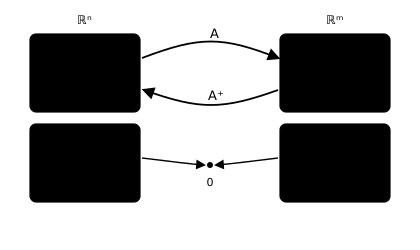
is a bijection from the row space onto the column space (stretching by the ); runs that bijection backward (shrinking by ) and sends the left nullspace to . So is the orthogonal projection onto the row space and is the orthogonal projection onto the column space.
Two familiar special cases
Section titled “Two familiar special cases”- Independent columns (, the least-squares setting): is invertible and is a left inverse, . Then is the least-squares solution.
- Independent rows (, the underdetermined setting): is invertible and is a right inverse, . Then is the shortest solution of , as the theorem below shows.
The minimum-norm solution
Section titled “The minimum-norm solution”When has many solutions, they form an affine flat . The pseudoinverse picks out the one closest to the origin.
This is the second half of a single picture: for an overdetermined system the pseudoinverse delivers the least-squares fit, and for an underdetermined one it delivers the minimum-norm solution. In the general rank-deficient case it does both at once, returning the shortest of all least-squares minimizers.
The Moore–Penrose characterization
Section titled “The Moore–Penrose characterization”The construction above is via a particular SVD, but does not depend on the choice. It is the unique matrix satisfying the four Moore–Penrose conditions
The first two say acts as an inverse where it can; the last two say the products and are symmetric, hence orthogonal projections onto the column space and row space respectively.