Stopping Times
A stopping time is a random time at which the decision to stop can be made using only the information available so far, with no glimpse of the future. It is the right notion of time for martingale arguments. Freezing a process at a stopping time gives the stopped process, the construction behind the optional sampling theorem.
Stopping times
Section titled “Stopping times”The three formulations are interchangeable. The event is a union of events each lying in , so for all gives for all . Conversely recovers the first from the second, using . The third is the complement of the second. The condition says exactly that whether the time has arrived by step is decidable from the information in hand at step .
We know it happens when it happens. Whether can be determined at time , without waiting to see what comes later.
Example: a hitting time
Section titled “Example: a hitting time”The canonical stopping time is the first time an adapted process reaches a level.
For an adapted process and a level , the first hitting time is
It is a stopping time, because the event of arriving at step unpacks into conditions on only:
each set on the right being -measurable since the process is adapted.
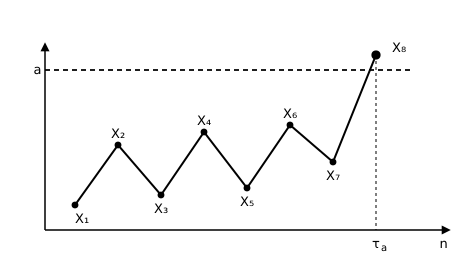
The path stays below through and first reaches it at , so . The event is decided by alone, hence lies in : we recognize the hitting time exactly when it occurs.
Example: a time that is not a stopping time
Section titled “Example: a time that is not a stopping time”Contrast this with the last time a process is above the level before a fixed horizon ,
Now the event of occurring at step requires knowing that the process never returns above afterward:
and the second set depends on the future values , which does not know. So is not a stopping time. We will see the last upcrossing happen, but only in hindsight at the horizon , never at the moment it occurs, which is exactly what the intuition above rules out.
“I didn’t know it was the last time I would see her.”
Stopped processes
Section titled “Stopped processes”Once we have a stopping time, we can freeze a process at it: run the process normally until time , then hold its value constant from then on.
Before the stopping time it agrees with ; from the stopping time onward it stays frozen at the value . The process stops after the stopping time.
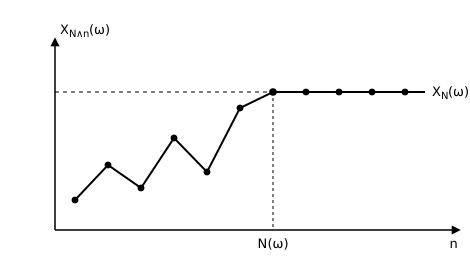
The stopped process follows up to the stopping time and then holds the value for every later . Freezing in this way preserves the (super/sub)martingale property.
The central fact is that freezing at a stopping time costs nothing: a stopped martingale is still a martingale. This follows immediately from the martingale transform, once we recognize the stopped process as a discrete stochastic integral.
The identity holds for every fixed , no matter how the stopping time is chosen. Whether it survives in the limit , that is, whether for the stopping time itself, is a more delicate question, and is the subject of the optional sampling theorem.