The Portmanteau Theorem provides several equivalent definitions of weak convergence. It connects the convergence of distribution functions to the convergence of expectations of bounded continuous functions and probabilities of μ-continuity sets.
Assume condition 2 holds: E[f(Xn)]→E[f(X)] for all bounded continuous f.
We want to show Fn(x)→F(x) for any point x where F is continuous.
Note that Fn(x)=E[1(−∞,x](Xn)]. The indicator 1(−∞,x] is not continuous (jump at x), so we cannot apply condition 2 directly.
Instead, we approximate the indicator function with continuous functions.
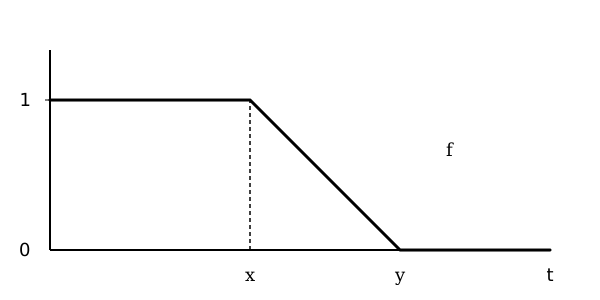
For any x and any y>x, define a continuous function fx,y(t):
f(t)=⎩⎨⎧1y−xy−t0t≤xx<t<yt≥y
Observe that 1(−∞,x]≤f≤1(−∞,y].
Upper Bound
Fn(x)=E[1(−∞,x](Xn)]≤E[f(Xn)]
Taking limit superior as n→∞:
n→∞limsupFn(x)≤n→∞limE[f(Xn)]=E[f(X)]
(The limit exists by condition 2).
Also, E[f(X)]≤E[1(−∞,y](X)]=F(y).
So:
n→∞limsupFn(x)≤F(y)for any y>x
Since F is a CDF, it is right-continuous. Taking y↓x, we get:
n→∞limsupFn(x)≤F(x)
Lower Bound
By a symmetric argument, construct a function g such that 1(−∞,z]≤g≤1(−∞,x] for z<x.
Then:
F(z)≤n→∞liminfFn(x)for any z<x
Taking z↑x:
F(x−)≤n→∞liminfFn(x)
(where F(x−) is the limit from the left).
Conclusion
Combining the bounds:
F(x−)≤n→∞liminfFn(x)≤n→∞limsupFn(x)≤F(x)
If F is continuous at x, then F(x−)=F(x).
The inequalities collapse to an equality:
Similarly, given XndX, we use the Skorohod construction (Yna.s.Y).
Let A be a μ-continuity set, meaning μ(∂A)=0.
Consider the indicator function f=1A. Note that f is continuous everywhere except on the boundary ∂A. Since μ(∂A)=0, Y falls in the continuity set of f almost surely.
Thus: