Intuitively, a random variable represents a numerical value determined by the outcome of a random experiment. For example, if we roll a die, the outcome is “the face that shows up”, and a random variable X could be “the number of dots on the face”.
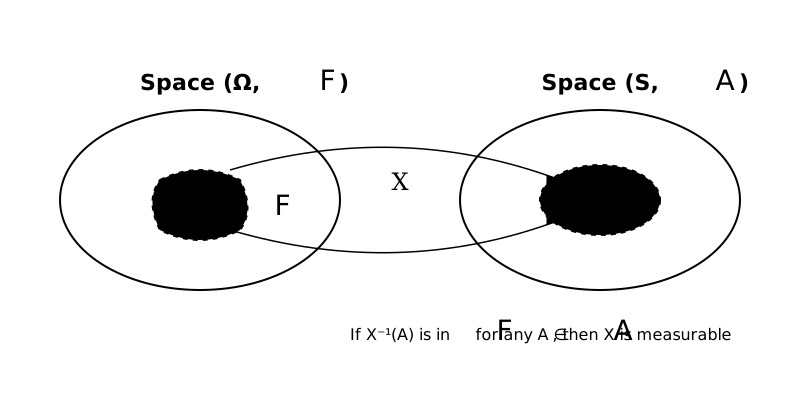
In our formal framework, we define a random variable as a function mapping the sample space to real numbers. But not just any function — it must preserve the structure of our probability space.
We want to be able to answer probabilistic questions about X, such as “What is the probability that X is greater than 5?”. In set notation, we are asking for P({ω:X(ω)>5}).
For this probability to be defined, the subset {ω:X(ω)>5} must be an event (i.e., it must belong to F), because the probability measure P is only defined on F. The condition X−1(B)∈F ensures precisely this: for any “reasonable” question we ask about the value of X (represented by a Borel set B), the set of outcomes satisfying it is an event we can measure.
Every random variable X naturally comes with a σ-field that describes the information contained in X.
Intuition:σ(X) is the smallest σ-field on Ω that makes X a random variable. It contains exactly the events whose occurrence (or non-occurrence) can be determined just by knowing the value of X. If σ(X) is smaller than F, it means X “forgets” some information about the outcome ω.