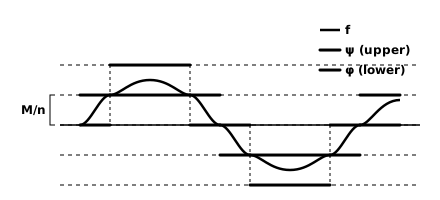
We now extend our definition of the integral from simple functions to bounded functions supported on a set of finite measure.
Let f f f f ( x ) = 0 f(x) = 0 f ( x ) = 0 x ∈ E c x \in E^c x ∈ E c E E E finite measure (μ ( E ) < ∞ \mu(E) < \infty μ ( E ) < ∞
We say f f f supported on a set with finite measure .
Recall the Riemann integral strategy: approximate the area from below and above using rectangles (step functions). We do the same here using simple functions.
Consider the following two values:
I ∗ ( f ) = sup φ ≤ f ∫ φ d μ and I ∗ ( f ) = inf ψ ≥ f ∫ ψ d μ I_*(f) = \sup_{\varphi \le f} \int \varphi \, d\mu \quad \text{and} \quad I^*(f) = \inf_{\psi \ge f} \int \psi \, d\mu I ∗ ( f ) = φ ≤ f sup ∫ φ d μ and I ∗ ( f ) = ψ ≥ f inf ∫ ψ d μ where the supremum and infimum are taken over all simple functions φ , ψ \varphi, \psi φ , ψ E c E^c E c
Inequality 1:
Since φ ≤ f ≤ ψ \varphi \le f \le \psi φ ≤ f ≤ ψ φ ≤ ψ \varphi \le \psi φ ≤ ψ
∫ φ d μ ≤ ∫ ψ d μ \int \varphi \, d\mu \le \int \psi \, d\mu ∫ φ d μ ≤ ∫ ψ d μ Taking the supremum over φ \varphi φ ψ \psi ψ
sup φ ≤ f ∫ φ d μ ≤ inf ψ ≥ f ∫ ψ d μ ⟹ I ∗ ( f ) ≤ I ∗ ( f ) — (1) \sup_{\varphi \le f} \int \varphi \, d\mu \le \inf_{\psi \ge f} \int \psi \, d\mu \quad \implies \quad I_*(f) \le I^*(f) \quad \textcolor{gray}{\text{--- (1)}} φ ≤ f sup ∫ φ d μ ≤ ψ ≥ f inf ∫ ψ d μ ⟹ I ∗ ( f ) ≤ I ∗ ( f ) — (1) To define the integral, we want these two values to be equal. We can show this by constructing a specific sequence of simple functions that converges to f f f
Since f f f ∣ f ( x ) ∣ ≤ M |f(x)| \le M ∣ f ( x ) ∣ ≤ M x x x n n n [ − M , M ] [-M, M] [ − M , M ] M / n M/n M / n
E k = { x ∈ E : k M n ≥ f ( x ) > ( k − 1 ) M n } for k = − n , … , n (and k ≠ 0 logic handles 0 ) E_k = \left\{ x \in E : \frac{kM}{n} \ge f(x) > \frac{(k-1)M}{n} \right\} \quad \text{for } k = -n, \dots, n \text{ (and } k \ne 0 \text{ logic handles } 0) E k = { x ∈ E : n k M ≥ f ( x ) > n ( k − 1 ) M } for k = − n , … , n (and k = 0 logic handles 0 ) Now define the approximating simple functions:
ψ n ( x ) = ∑ k = − n n k M n 1 E k (Upper approximation) \psi_n(x) = \sum_{k=-n}^{n} \frac{kM}{n} \mathbb{1}_{E_k} \quad \text{(Upper approximation)} ψ n ( x ) = k = − n ∑ n n k M 1 E k (Upper approximation) φ n ( x ) = ∑ k = − n n ( k − 1 ) M n 1 E k (Lower approximation) \varphi_n(x) = \sum_{k=-n}^{n} \frac{(k-1)M}{n} \mathbb{1}_{E_k} \quad \text{(Lower approximation)} φ n ( x ) = k = − n ∑ n n ( k − 1 ) M 1 E k (Lower approximation) We approximate f f f ψ n \psi_n ψ n φ n \varphi_n φ n k M / n kM/n k M / n
Note that for any x ∈ E x \in E x ∈ E
ψ n ( x ) − φ n ( x ) = M n 1 E ( x ) \psi_n(x) - \varphi_n(x) = \frac{M}{n} \mathbb{1}_E(x) ψ n ( x ) − φ n ( x ) = n M 1 E ( x ) Integrating this difference:
∫ ( ψ n − φ n ) d μ = ∫ M n 1 E d μ = M n μ ( E ) \int (\psi_n - \varphi_n) \, d\mu = \int \frac{M}{n} \mathbb{1}_E \, d\mu = \frac{M}{n} \mu(E) ∫ ( ψ n − φ n ) d μ = ∫ n M 1 E d μ = n M μ ( E ) Now, observe that:
sup φ ≤ f ∫ φ d μ ≥ ∫ φ n d μ = ∫ ψ n d μ − M n μ ( E ) ≥ inf ψ ≥ f ∫ ψ d μ − M n μ ( E ) \sup_{\varphi \le f} \int \varphi \, d\mu \ge \int \varphi_n \, d\mu = \int \psi_n \, d\mu - \frac{M}{n} \mu(E) \ge \inf_{\psi \ge f} \int \psi \, d\mu - \frac{M}{n} \mu(E) φ ≤ f sup ∫ φ d μ ≥ ∫ φ n d μ = ∫ ψ n d μ − n M μ ( E ) ≥ ψ ≥ f inf ∫ ψ d μ − n M μ ( E ) Taking the limit as n → ∞ n \to \infty n → ∞ μ ( E ) < ∞ \mu(E) < \infty μ ( E ) < ∞ M n μ ( E ) → 0 \frac{M}{n}\mu(E) \to 0 n M μ ( E ) → 0
sup ∫ φ ≥ inf ∫ ψ — (2) \sup \int \varphi \ge \inf \int \psi \quad \textcolor{gray}{\text{--- (2)}} sup ∫ φ ≥ inf ∫ ψ — (2) Combining (1) and (2), we have equality!
sup φ ≤ f ∫ φ d μ = inf ψ ≥ f ∫ ψ d μ \sup_{\varphi \le f} \int \varphi \, d\mu = \inf_{\psi \ge f} \int \psi \, d\mu φ ≤ f sup ∫ φ d μ = ψ ≥ f inf ∫ ψ d μ We define the Lebesgue Integral of f f f
∫ f d μ : = sup φ ≤ f ∫ φ d μ \int f \, d\mu := \sup_{\varphi \le f} \int \varphi \, d\mu ∫ f d μ := φ ≤ f sup ∫ φ d μ
Prove that Properties 1-6 for simple functions (Linearity, Monotonicity, etc.) also hold for bounded functions with finite support.
Use the fact that for any bounded function f f f φ n \varphi_n φ n φ n → f \varphi_n \to f φ n → f n → ∞ n \to \infty n → ∞