Setting: Measure space (Ω,F,μ). Note that μ is not necessarily a probability measure.
We assume μ is σ-finite, meaning that:
∃A1,A2,…∈F such that μ(An)<∞∀n and ⋃n=1∞An=Ω.
Goal: Define the Lebesgue integral for general functions, building from simple functions.
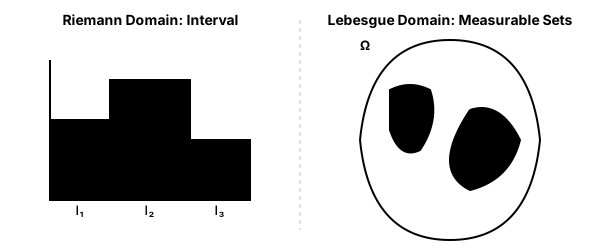
Simple functions are the Lebesgue counterpart of step functions used for Riemann integrals.
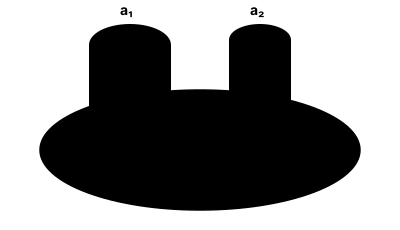
In the Lebesgue setting, we don’t need the domain to be the real line or partitioned into intervals. Any measurable subset Ai can serve as the base for a constant value.
In this simple case, the integration is just the volume (height × size of set) of the region under the function, i.e.,